just the activity by which poets achieve their fame. A vast amount of literary criticism can be dismissed outright on this basis.
Consider pop music, by contrast. The technique and technology of pop make the pop song available as a vehicle to the ambitious young man or woman who wants to become famous. It is like any other tool. You buy it and use it to some end. There is no guarantee that you'll succeed, of course; the point is merely that the song's only value lies in the end it achieves for the would-be star. It has no aesthetic value, only an instrumental one.* A poem, however, lacks the institutional immediacy to present itself to the public as a temporary means to the end of the poet's destiny. The poem is itself the poet's destiny. It is permanent or it is nothing.
The surrealists wanted to put poetry (art in general) at the service of the revolution. They were half kidding, of course. The impossibility of revolution does not render artistic activity meaningless. It is meaning.
The situationists reversed it: they wanted to put the revolution at the service of poetry. Again, the impossibility of revolution does not undermine the possibility of poetry.
___________
*Before you defend one or another gem of a pop song as "art" in its own right, keep in mind that I'm thinking of pure forms here. Some songs accomplish, within the technical and institutional framework of pop an "aesthetic" quality that is often admirable. (I can enjoy any number of popular songs.) But in these cases poetry (art) struggles against "the industry" (commerce). And the artist is, damn blast yer intellex, complicit in the compromise. You cannot record a popular song for purely artistic reasons. But you can (and must) write a poem for such reasons.
Wednesday, January 30, 2013
Poetry is not


Tuesday, January 29, 2013
Institutions and Media
Some things are experienced immediately. We know right away what we're looking at, what we're dealing with. I'm not talking about moments of instant recognition, about which we could be mistaken. I'm talking about the comfortable way in which we know our way home through the park. The certainty that this is the park, which would be true even in a dream (a dream about the park). I'm talking about what it is like to be at home in the ordinary way.
I thought about this when Liam Stanley tweeted the following slide to explain "what, exactly, an institution is in political and social science":
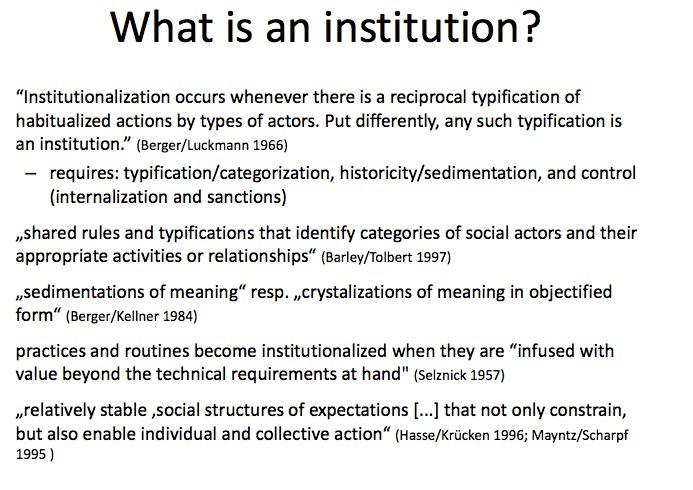
These are all perfectly good definitions. But I've always thought we should define institutions in contrast to mediated forms of experience. If you have to ask what an action means, it is not "typical", i.e., it is not institutionalized.
I think specifically of Kant's definition of intuition as a model. Intuition is that through which knowledge of things is given to us immediately. The "that through which" is important because it actually suggests mediation (going through something). So intuition is the medium of immediate knowledge, almost a contradiction in terms.
But then, immediacy is probably an essentially paradoxical notion.
Anyway, institution is that through which the power of people is taken from them immediately. Or the way in which people are immediately taken with experience. Institution is the immediacy of people in experience. (What one definition refers to as the identification of "categories of social actors".) Institution is the immediacy of social experience.
Likewise, intuition is the immediacy of material experience. We experience the world as a collection of things because of intuition. We experience history as a collective of people because of institution.
_________
Update (02-10-2016): Reading this just now it occurred to me that intuition/institution is that through which knowledge/power is distributed in experience immediately. It is the immediacy of sense and motive in experience. That is, institutions don't just take power from people. It is also the medium in which they, immediately, have certain powers. Likewise, intuitions don't just reveal things immediately in any give situation, they also conceal things.
Monday, January 21, 2013
Mayhew's Duende, and Mine
Last night I left a somewhat unhinged comment on Jonathan's post about the duende. This post is just a slightly cleaned up version of that.
I was struck by Jonathan's description of me as a "Danish reader". I don't think there's anything very Danish about my reading of Apocryphal Lorca, and I've never really liked the idea of national literatures. (Pound says that we should no more speak of "American literature" than we should speak of "American chemistry".) In fact, much of the "apocrypha", the kitsch, surrounding the duende derives from tying it essentially to Andalusia. Still, there is of course a way to understand the duende by way of the socratic daimon, which inspired, if you will, much of Kierkegaard's work. In particular, we can distinguish between the "genius" and the "apostle". And we can note that too many readings of both Lorca and Heidegger do not proceed from the reader's own particular genius, but the desire to be an apostle.
Jonathan writes that the duende "is a name for Lorca’s own exceptional poetics, universalizable, in principle, but also irreducibly his own." I think that exactly captures the nature of the interpretative problem, and the problem of translation. He goes on: "In Apocryphal Lorca I suggested the duende—an untranslatable term—was at the same time a master trope for translation itself." Yes, but he also questioned its untranslatability, and suggested (at least to me) that its misreading, and reduction to kitsch, is a function, precisely, of the insistence of translators and followers not to find an equivalent notion in their own language. The whole point of the duende (if we take it "as master trope for translation itself") is that you must appropriate the translated work. The duende is not about Lorca or Spain. It is about you, dear reader.
Kierkegaard says somewhere that if you have to ask how and when sin came into the world, you haven't understood the question. It's sort of like that. "It took eighteen centuries of Christendom," writes Norman Mailer, "before Kierkegaard could come back alive with the knowledge that ... the characteristic way modern man found knowledge of his soul [was] ... by the act of perceiving that he was most certainly losing it." (From the preface to Deaths for the Ladies, reprinted in Existential Errands.) That is, we learn about existence for ourselves, because existence simply is the mystery of self in the world.
The duende is universal and therefore translatable into the name of the ineffable breath of genius in all languages and traditions (daimon, muse, genii, what have you). The idea of Mayhew's duende is jarring (a much needed jolt) for the same reason that, say, Basbøll's Dasein would be jarring. We think these concepts, if they mean anything at all, can only mean what Lorca and Heidegger meant by them. But that misses what Heidegger calls the "in each case mine". Or as Pound said: metaphysics is that about which we can only know what we find out for ourselves. This, I guess, is "what Lorca knew".
By invoking his own duende, or Dasein for that matter, Jonathan is merely (and rightly) insisting on the universal (primordial) meaning of the term. We can go further (via Saint Teresa, perhaps): when Jesus said he was God's son he didn't mean that he, alone, was God's son, he meant we all are. The kitsch of Christianity, then, comes from granting this claim to only one man, who "walked the earth", etc. It was an attempt to stave off a general emancipation with talk of a miracle, an exception. The good news, meanwhile, was meant to be universal. And that was why Kierkegaard ultimately could not call himself a "Christian".
I'm no expert on Lorca's duende. (Nor, for that matter, on Heidegger's Dasein.) But the issue here is what kind of "expertise" is required. Mayhew's approach teaches us (or at least me) to think outside the frame of Spanish, and indeed Lorquian, "exceptionalism" (a frame within which I'm in any case unqualified to think) and try instead to understand, in my own case, "the subtle link that joins the five senses to the living flesh". Likewise, we cannot continue to think of an expert on Dasein as necessarily an apostle of Heidegger. We must, finally, find our own genius.
Saturday, January 19, 2013
Image and Meaning
I feel like I'm on the verge or cusp of an insight.
I've been reading a book by Richard Biernacki called Reinventing Evidence, which draws attention to the puzzling status of "the fact of meaning" in the social sciences. Texts and practices are meaningful and the social sciences (especially ethnography) tells us what they mean—what they mean.
They try to describe human activities as underpinned by (the) facts (of their meaning) to be discovered. And this raises the question of method. The social sciences provide us with a "theory of meaning" for social phenomena, a science of their interpretation. So they must have a "method", which gives them access to the "facts".
The humanities, I sometimes argue, don't have theory and method. They have style.
So we have a choice. We can engage stylishly with our culture or we can undertake to know the facts of social life.
The second option forces us to search, not just for "the meaning of life", but for its particular meanings (pl.). The first, by contrast, and which I favor, requires imagination. It says, not that there are meanings that must be brought out from under the phenomenal flux of experience by means of a method, but rather, and trivially, that there are images, that we imagine things, and, somewhat less trivially, that who we are is shaped by this imagery.
On this view, there is no truth about social life until we understand it.
Like I say, I'm only just now leaning into this insight.
Monday, January 14, 2013
Truths and Rights
I normally say that the pangrammatical supplement of "truth" is "justice". This has much to recommend it, but also one clear defect that I've noted before: there are "truths" in the world, but not corresponding "justices".
I just discovered a way to resolve this problem that might be more elegant than I previously suggested. Can we not distinguish simply between "truth" and "rightness" (i.e., justice). Our beliefs about the world are true and false, while our desires about history are right and wrong.
This also lets us posit truths and rights, and I mean "rights" in the ordinary sense. A right is just an individual just-ness. Our experience, then, is subtended by truths and rights.
Now, the truths are known to us or not. While the rights are mastered by us or not.
(Note that social progress since, say, the Enlightenment has consisted in the increasing mastery of the rights that, we increasingly recognized, we already had.)
One big issue is whether all grounding of actions depends on rights. Are some "abilities" not grounded in "skills"? This is where moral and practical "rightness" intersect. There are right and wrong ways to do things, but there is no simple way to distinguish the social license we have for action from physical ability we have to do it.
We have a "right" to do something, or not. We are able to do it or not.
"You're doing it wrong!"
"What you did was wrong!"
Both of these expressions depend on the experience of an action having "rightness". When we propose "inalienable human rights" or suchlike, are we not just saying that, just as our experience gives us access to truths, it affords us rights?